

The Recovered
Capacity Principle
One of the easiest mistakes in AI economics is confusing time saved with value created.
A company introduces AI into a workflow. The work gets faster. Employees save hundreds, perhaps thousands, of hours. The project reports a significant productivity gain.
Then someone multiplies those hours by an hourly labour cost and calls the result savings. The calculation looks reasonable.
But economically, something may be missing.
The employees are still there.
The payroll is still being paid.
What the organization may have created isn’t necessarily a cash saving. It has created capacity. And what happens to that capacity matters.
Productivity creates potential.
Suppose AI gives a salesperson five hours back every week. Those five hours have value, but their economic value isn’t predetermined.
If nothing meaningfully changes, the salesperson may simply be doing the same job with more available time.
But what if those five hours are redirected toward more customer conversations, developing new opportunities, strengthening existing accounts or pursuing business that previously went unattended?
Now the productivity improvement is beginning to affect the business.
But economically, something may be missing.
AI can create the capacity.
Management determines what that capacity becomes.
This is the Recovered Capacity Principle.
THE CAPACITY CONVERSION CHAIN
From operational improvement to economic value
The distance between time saved and value realized
is where much of the economics lives.
Time saved isn’t the same as capacity recovered.
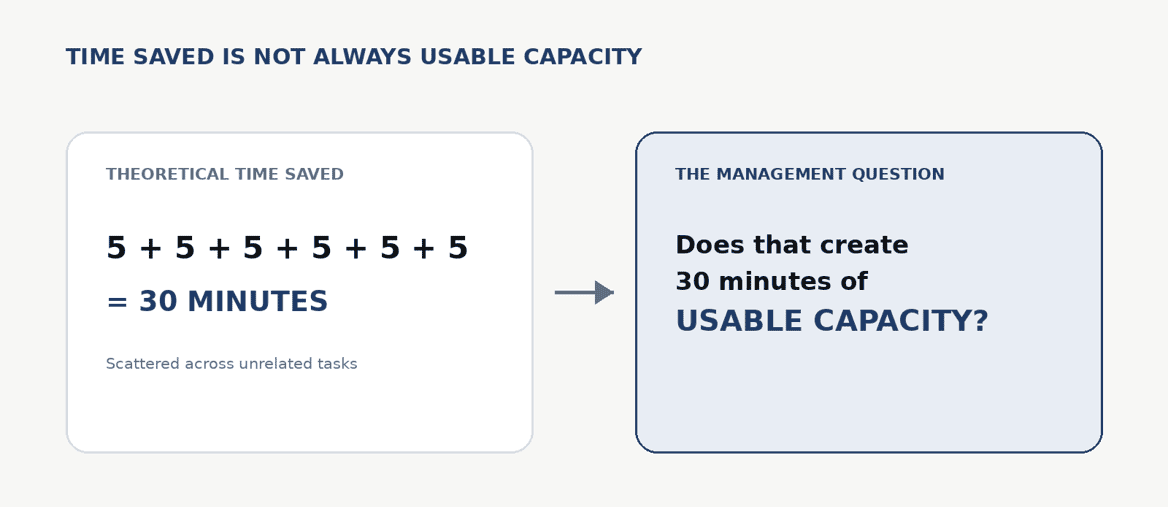
Not every minute saved becomes usable capacity.
Saving five minutes across six unrelated activities may technically save thirty minutes. But those scattered minutes don’t necessarily become a useful thirty-minute block that can be redirected somewhere else.
Work is fragmented. Priorities change. Meetings remain. New work appears.
That’s why theoretical time saved and usable capacity recovered aren’t always the same thing.
Consider 1,000 hours.
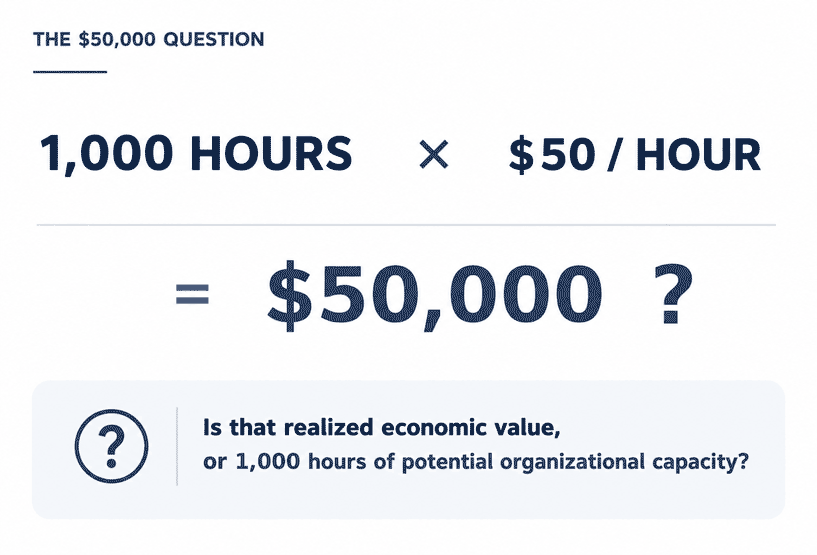
Imagine an AI initiative is projected to save 1,000 employee hours annually.
At an estimated labour cost of $50 per hour, it can be tempting to report $50,000 in savings.
But does $50,000 actually disappear from the organization’s costs? If the employees remain employed at the same compensation, perhaps not.
What the organization may have created instead is 1,000 hours of potential capacity. And that’s where the economic question becomes more interesting.
What can that capacity become?
Perhaps the organization can support additional growth without hiring another employee. That’s cost avoidance.
Perhaps salespeople redirect the capacity toward customers and opportunities. That’s growth potential.
Perhaps employees can serve more customers with the same resources. That’s increased capacity and throughput.
Perhaps employees have more time to improve quality, responsiveness or customer experience. That’s service improvement.
Perhaps specialized employees can spend more time applying the expertise the organization hired them for. That’s better allocation of expertise.
Same 1,000 hours.
Very different economics.
Value doesn’t always mean reducing costs.
Recovered capacity doesn’t have to produce another dollar of revenue to create value.
For a nonprofit or community organization, it might mean supporting more people with the same resources. For healthcare, it could mean giving clinicians more time with patients. For a business, it could mean giving salespeople more time with customers. For a manager, it might mean more time developing employees, solving problems or making better decisions.
The economic mechanism may differ. The management question remains:
What is this recovered capacity
intended to become?
A better AI ROI conversation.
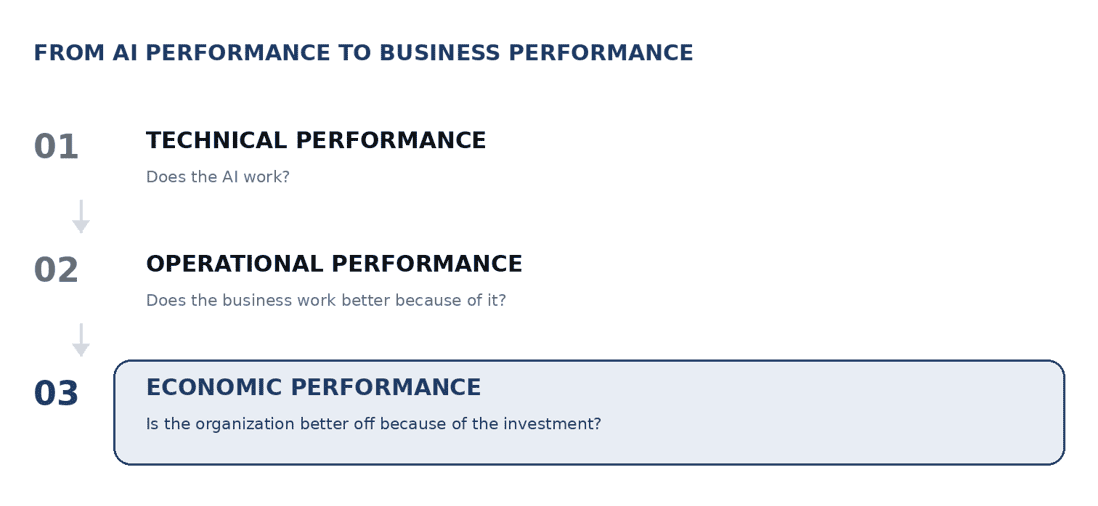
01 How many hours will AI save?
02 How much usable capacity will those hours actually create?
03 Where will that capacity go?
04 What measurable business outcome should change because of it?
Those questions connect productivity to economics. They also make it much harder to accidentally treat every efficiency improvement as financial return.
Not all AI value comes from recovered capacity.
The Recovered Capacity Principle applies specifically where AI reduces or changes human effort.
Fraud detection can reduce losses. Predictive maintenance can reduce downtime. Better forecasting can reduce inventory costs. Conversion optimization can increase revenue. Automation may directly reduce external expenses.
In these situations, recovered employee capacity may not be the primary economic mechanism.
How is this particular AI investment
expected to create value?
Recovered capacity is one answer. It isn’t the only one.
The management opportunity.
As AI becomes capable of performing more administrative, analytical and knowledge work, organizations may begin recovering significant amounts of human capacity.
That creates opportunity. But organizations will need to become increasingly deliberate about what they do with it.
Because the real economic question isn’t simply: How much time did AI save?
What became possible because
that capacity was available?
That is where productivity begins its journey toward economic value.
AI can createthe capacity
Managment determines what that capacity becomes.
What could recovered capacity mean for your organization?
Understanding where work consumes time, where capacity can be recovered and how that capacity could be redeployed is an important part of evaluating the economics of AI.