

The Hidden
Factory
Before making work faster, understand how it moves.
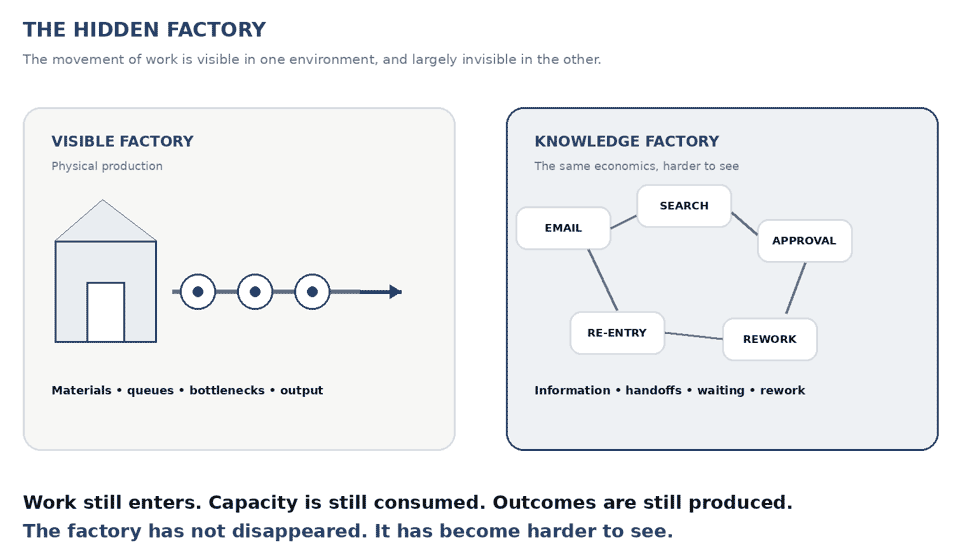
Most executives wouldn’t invest millions improving a factory without understanding how work moves through it.
Where materials enter. Where production slows. Where inventory accumulates. Where defects create rework. Where capacity is being lost.
But inside many organizations, the movement of knowledge work is much harder to see.
A request arrives by email. Someone searches for information. A spreadsheet gets updated. Another person gets involved. The work waits. An approval is required. Information gets entered again. Something needs correcting. Someone follows up. Eventually, an outcome emerges.
Work enters. Information moves. People intervene. Queues develop.
Capacity is consumed. Outcomes are produced.
Nobody calls this a factory. The factory is simply harder to see.
The idea isn’t new. The AI question is.
The concept of the Hidden Factory comes from established thinking in quality and operations management. It describes the work, rework and capacity consumption that organizations don’t always see clearly.
In knowledge organizations, much of this activity has become embedded inside email, meetings, spreadsheets, software, documents and departmental handoffs.
Are we improving the work,
or simply making one part of an inefficient workflow faster?
The task may not be the problem.
Much of the AI productivity conversation begins with individual tasks. Can AI write this email faster? Summarize this meeting? Prepare this report? Find this information? Answer this customer question?
All legitimate possibilities. But there is another question worth asking:
Why does the work move
this way in the first place?
Perhaps the employee shouldn’t have to search for the information. Perhaps the spreadsheet shouldn’t exist. Perhaps three people don’t need to touch the request. Perhaps information shouldn’t need to be entered twice. Perhaps the approval isn’t necessary. Perhaps the meeting can disappear entirely.
And perhaps AI isn’t the appropriate solution.
Some of the largest productivity opportunities may not exist inside individual tasks.
They may exist in the movement of work between them.
Invisible workflows create invisible economics.
Waiting doesn’t appear as a separate expense. Neither does searching, unnecessary handoffs, duplication, re-entry, rework or using specialized expertise for work that doesn’t require it.
But all of them can consume time, labour, information, expertise and capacity, and ultimately affect the organization’s ability to produce an outcome.
Instead of asking only, ‘How many hours could we automate?’
Ask, ‘How effectively are we converting organizational capacity into business outcomes?’
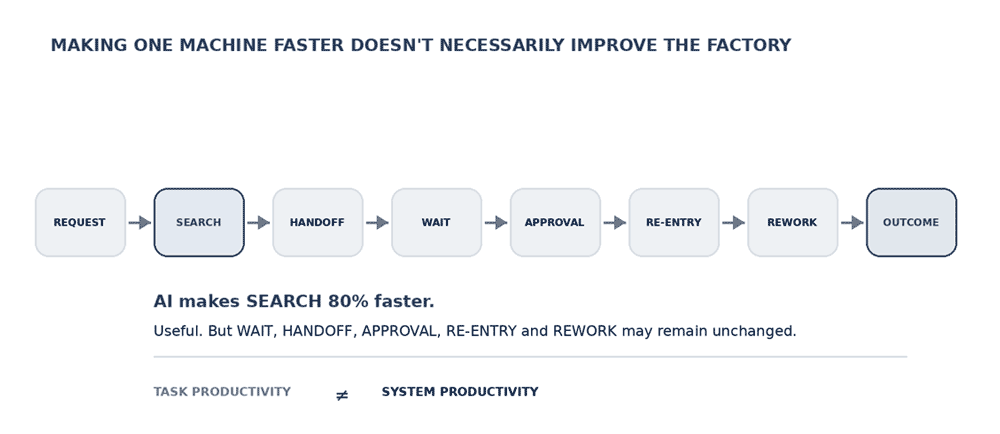
Making one machine faster doesn’t necessarily improve the factory.
Imagine AI makes the SEARCH stage dramatically faster. That’s useful.
But the work may still wait. It may still pass unnecessarily between people. It may still require redundant approval. The same information may still be entered twice. Errors may still create rework.
We made one machine inside the factory faster.
We haven’t necessarily improved the factory.
This is the difference between task productivity and system productivity. Before optimizing individual tasks, understand what is constraining the flow of the overall outcome.
Make the Hidden Factory visible.
01 ENTRY Where does work enter?
02 MOVEMENT How does it travel?
03 FRICTION Where does it stop, slow down or repeat?
04 JUDGMENT Where does human capability genuinely create value?
05 OUTCOME What is the organization ultimately trying to produce?
Once those five things become visible, the technology conversation changes.
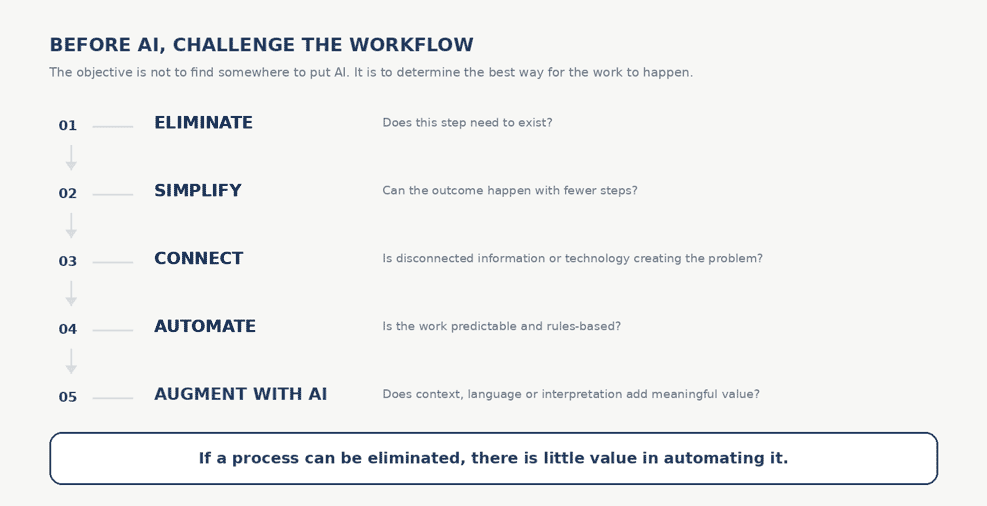
Before AI, challenge the workflow.
The objective isn’t to find somewhere to put AI. It’s to determine the best way for the work to happen.
Eliminate what does not need to exist. Simplify what can happen with fewer steps. Connect disconnected information and systems. Automate predictable, rules-based work. Then augment with AI where context, language, interpretation or intelligent interaction adds meaningful value.
If a process can be eliminated,
there is little value in automating it.
AI is one intervention. It shouldn’t automatically be the starting assumption.
Where should human judgment remain?
A senior employee might spend part of the day searching for documents, moving information, formatting reports, checking statuses and following up on approvals.
And another part solving difficult problems, developing relationships, making decisions, handling exceptions and applying specialized expertise.
Those hours may carry the same payroll cost. They don’t necessarily create the same economic value.
The opportunity isn’t necessarily to replace the employee.
It may be to redesign the workflow around where that person’s capability creates the most value.
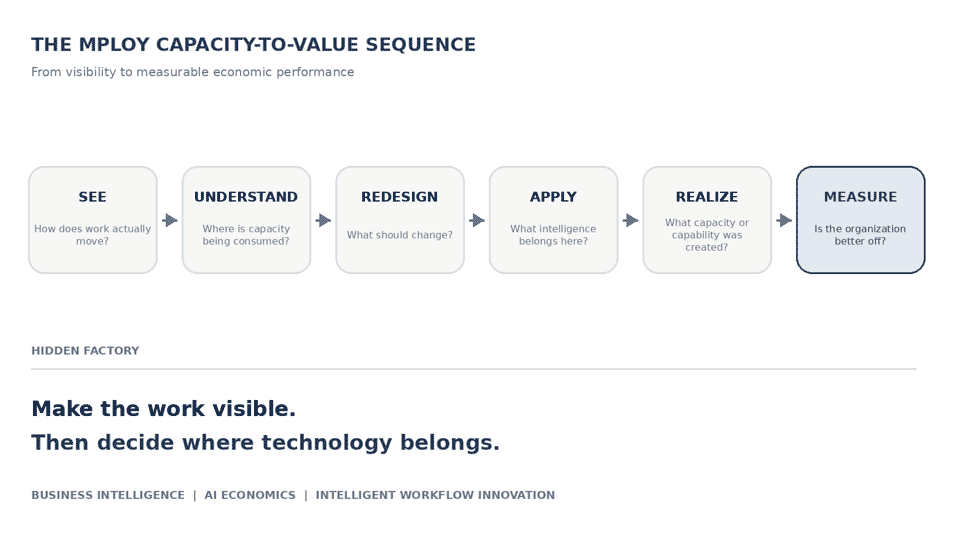
From the Hidden Factory to AI Economics.
Making work visible is only the beginning. The progression moves from seeing the work, to understanding friction, redesigning the flow, applying the appropriate intelligence, realizing usable capacity or capability, and finally measuring whether the organization is better off.
That last question matters. An AI implementation can work technically. It can make a task faster. It can even recover employee capacity. And there is still another question:
What changed
for the business?
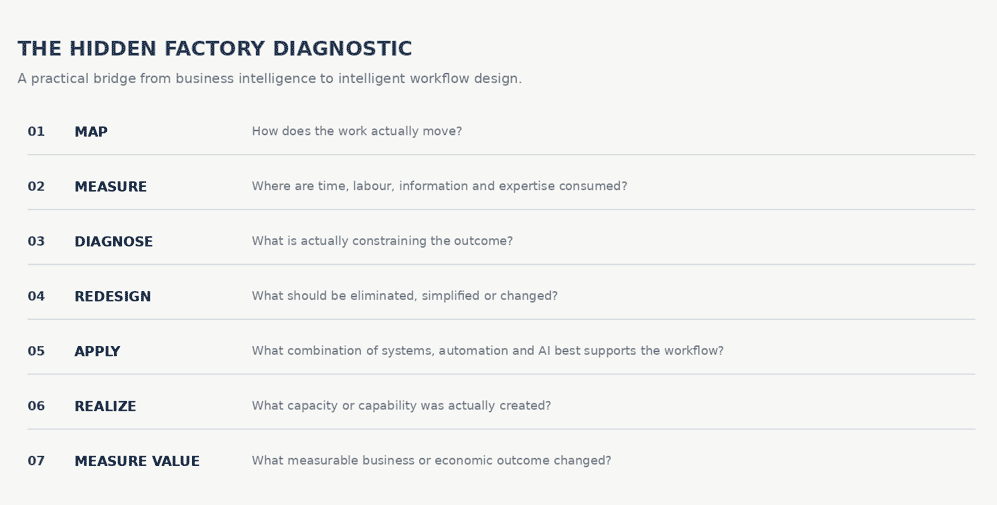
The Hidden Factory Diagnostic.
The diagnostic is the bridge between thought leadership and practical consulting. It makes the operating system of the business visible before deciding where technology belongs.
It is not an AI readiness checklist. It is a structured way to understand how the organization converts human capacity, information and technology into business outcomes, where value is being lost, and where intelligent workflow redesign could improve that conversion.
The executive question.
AI gives organizations increasingly powerful tools for changing how work gets done. But more technological capability doesn’t automatically create a better operating system.
Sometimes the most valuable discovery comes before the technology. A step doesn’t need to exist. Information shouldn’t be moving that way. An expert shouldn’t be doing that work. A system should already be connected. Or the real bottleneck is somewhere other than where management assumed it was.
Before asking, ‘Where can we use AI?’
Ask, ‘If you could see every piece of information and work moving through your organization, where would you see it piling up?’
Make the Hidden Factory visible first.