

The Opportunity Cost
of Expertise
The cost of expertise isn’t only what you pay for it. It’s what the organization gives up when that expertise is allocated elsewhere.
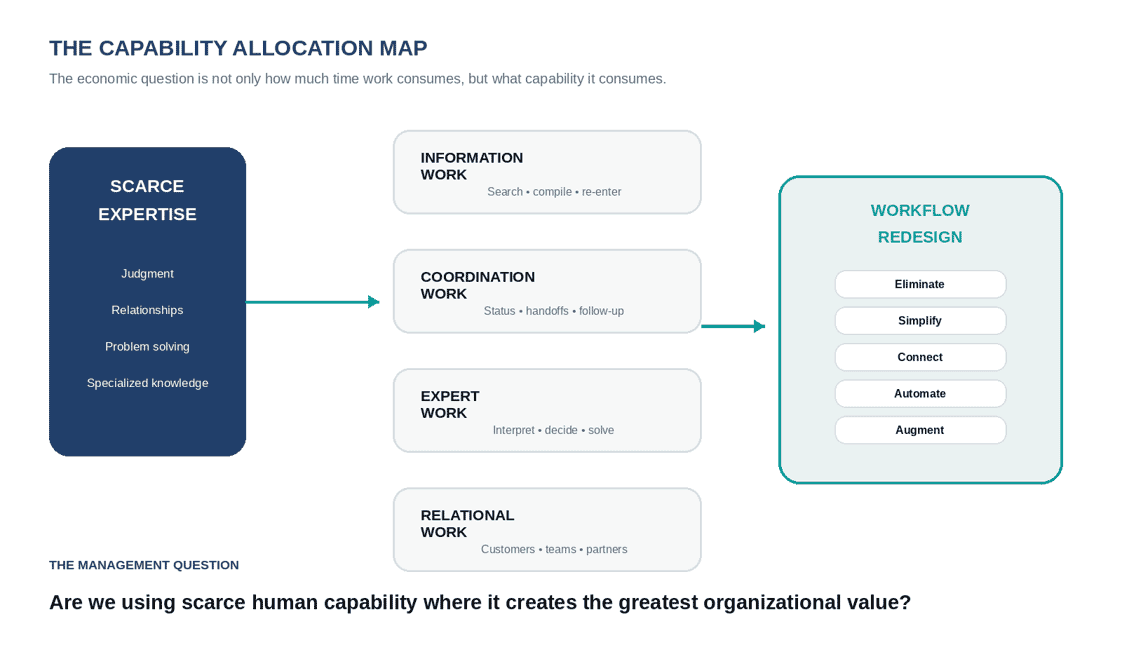
Organizations spend significant amounts of time trying to attract experienced people.
Senior managers. Salespeople. Engineers. Clinicians. Analysts. Technical specialists.
Their expertise is often difficult to find, expensive to develop and even harder to replace. Yet once that expertise is inside the organization, we don’t always examine how it is being used.
A senior employee can be extremely busy and still be poorly allocated.
That creates an economic question that becomes increasingly important as AI changes how work can be performed:
What is your scarce expertise actually being used to do?
Being busy isn’t the same as being well allocated
Consider an experienced salesperson. Part of their week may be spent searching for customer information, updating systems, preparing internal reports, coordinating activities, checking status, formatting documents or following up on administrative processes.
All of that work may need to happen. And the salesperson may be perfectly capable of doing it. But capability is not really the question.
Given everything this person could be doing,
is this where their expertise creates the greatest organizational value?
Because every hour allocated to one activity is an hour that cannot be allocated somewhere else. That is where opportunity cost enters the conversation.
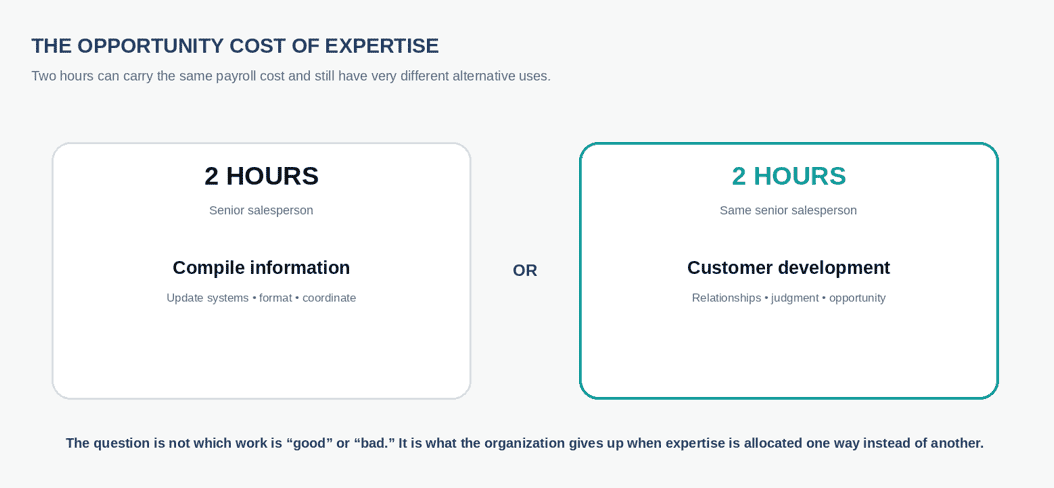
Expertise has an opportunity cost
Suppose a senior salesperson spends five hours each week assembling information and completing administrative work.
The obvious cost is their compensation for those five hours. But there is another cost that does not appear directly on the income statement.
What could those five hours have produced elsewhere? More customer conversations? New opportunities? Stronger strategic accounts? Coaching less experienced salespeople? Pursuing business that currently goes unattended?
The answer is not automatically revenue. But the alternatives matter.
The cost of expertise isn’t only what you pay for it.
It includes what the organization gives up when that expertise is allocated elsewhere.
This is the Opportunity Cost of Expertise.
Scarce expertise isn’t necessarily expensive expertise
When we talk about valuable expertise, we do not simply mean highly paid executives. Scarce expertise can exist throughout an organization.
It may be a technician who understands equipment nobody else understands. An employee who has developed years of institutional knowledge. A clinician with specialized expertise. An account manager with deep customer relationships. An experienced estimator who recognizes problems others miss. Or a manager whose judgment allows difficult decisions to be made quickly.
Their importance is not determined simply by salary. What matters is how difficult that capability is to replace, scale or substitute, and how strongly it influences important outcomes.
Where do we have capabilities that are genuinely scarce?
And what are we using those capabilities to do?
The work itself isn’t necessarily the problem
Searching, documenting, coordinating, reporting and administrative work are not inherently low-value. They may provide context, maintain quality, strengthen customer understanding or be important to professional judgment.
Removing every routine activity from experienced people could actually make their jobs worse.
The objective is not to remove experienced people from routine work.
It is to understand whether the current mix of work represents an effective use of their capability.
AI changes the allocation possibilities
Historically, organizations had a relatively limited number of ways to deal with work consuming scarce expertise: hire someone else, delegate it, outsource it, standardize it, automate it or simply accept it.
AI introduces another set of possibilities. Technology can increasingly assist with searching, summarizing, drafting, classification, analysis, coordination and information retrieval.
But that does not mean every task should be handed to AI.
AI can change how work is allocated between people and technology.
The objective is not maximum automation. It is better allocation.
Some work should remain human. Some should be automated. Some should be AI-assisted. Some should be redesigned. Some may not need to exist at all. 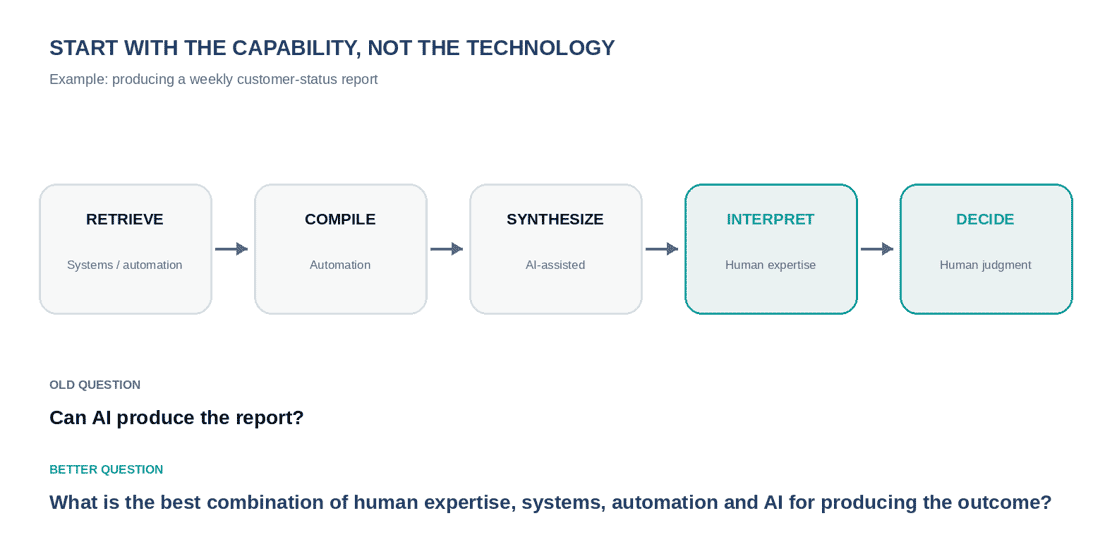
Start with the capability, not the technology
Traditional workflow analysis often asks: Who performs this task? There may be a more useful question for the AI era: What capability does this task actually require?
Consider a weekly customer-status report. Information retrieval may require systems. Compilation may require automation. Initial synthesis may be assisted by AI. Interpretation may require experience. Customer implications may require human judgment. Final decisions may require the account manager.
The question is not simply, “Can AI produce the report?”
What is the best combination of human expertise, systems, automation and AI for producing the outcome?
That is intelligent workflow design.
From expertise allocation to AI Economics
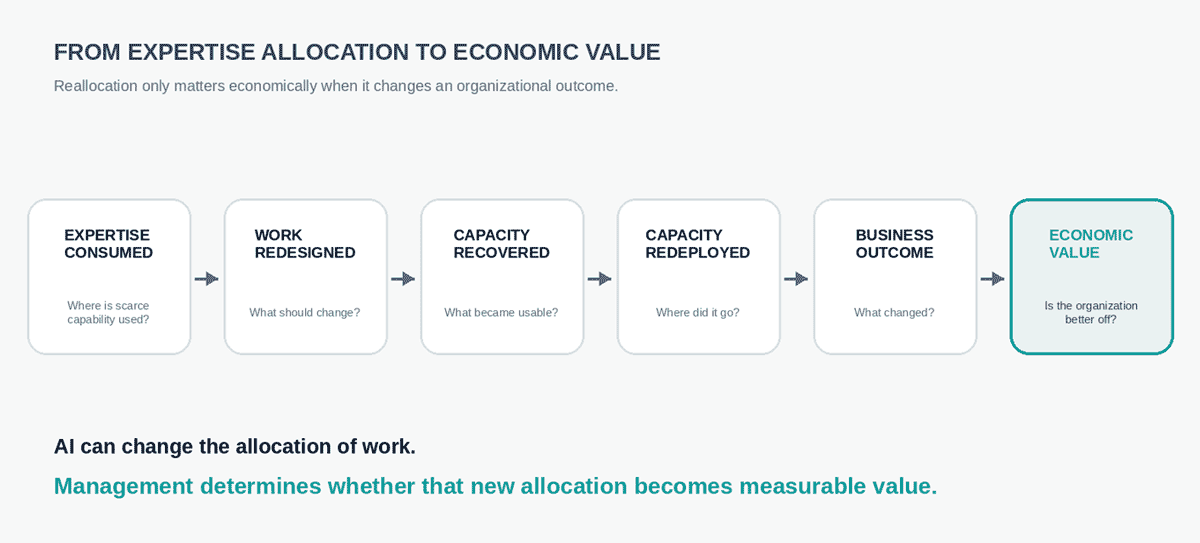
Now the economic chain becomes clearer. First understand where scarce expertise is being consumed. Redesign the work. Determine how much genuinely usable capacity becomes available. Decide where that capacity should be redeployed. Then measure what changed for the organization.
This is where the Opportunity Cost of Expertise connects directly to the Recovered Capacity Principle.
AI can change the allocation of work.
But reallocating work is not automatically economic value. The value depends on what happens next.
Consider the salesperson again
Imagine workflow redesign and AI assistance release five genuinely usable hours from a salesperson’s week.
SCENARIO A Nothing materially changes. Capacity has been recovered, but little economic value has been realized.
SCENARIO B The salesperson uses the time for additional customer conversations. Recovered capacity has been redeployed toward growth.
SCENARIO C The business is growing and would otherwise have hired another salesperson. The additional capacity may create avoided cost.
SCENARIO D The salesperson spends more time developing junior employees. The capacity creates organizational leverage rather than immediate revenue.
Same technology. Same employee. Potentially the same hours recovered.
Different economics.
This changes the talent conversation
Organizations frequently say, “We need more people.” Sometimes they absolutely do.
But before treating every capacity constraint as a recruitment problem, there is another question worth asking:
Are we short on talent,
or is scarce talent being consumed by the way work is designed?
That question does not assume AI is the answer. The problem could be a broken process, poorly connected systems, unnecessary approvals, duplicated work, bad information architecture, unclear responsibilities or technology that creates more work than it removes.
The purpose of making work visible is to understand the constraint before prescribing the intervention.